

Starna Optical Coatings

Optiglass now has a variety of optical coating equipment which includes electron bombarded sources with automated deposition control. In addition, the use of Thin Film Design Software enables Optiglass to offer a range of optical coatings which can be applied to any suitable optical surface. The main categories of coatings are as follows:
ANTI-REFLECTION COATING
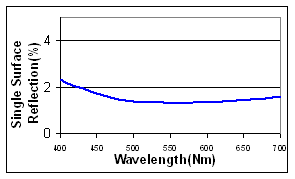
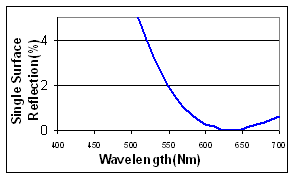
| Single Layer Anti-Reflection Coatings | Laser Line Anti-Reflection Coatings(V-Coatings) | |||||
| MgF2 Single Layer AR | V-Coat @ 633 Nm | |||||
 |
 |
|||||
|
||||||
Broadband Multilayer Anti-Reflection Coatings |
||||||
| Visible Broadband AR | Cuvette Coating | |||||
 |
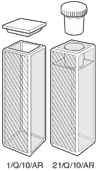
some fluorescent applications
require either or both the excitation and emission energy to be enhanced
by applying a metallic mirror coating to the outside of adjacent windows
opposite to the source and the detector windows. Similarly, anti-reflection
coatings on the other windows reduce reflective losses. |
 |
||||
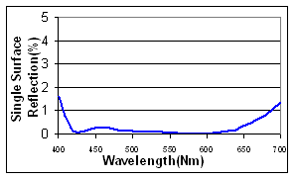
| This type of coating provides
much lower reflectance than that obtained from a single layer of Magnesium
Fluoride. This multilayer coating typically achieves less than 0.3%
reflection per surface over the range 425-675 Nm. The coating is available for other wavebands and for various refractive index of glass. In addition, dual-band coatings(e.g. visible and 1064 Nm) are available. |
|
|||||
BEAM SPLITTER COATINGS |
||||||
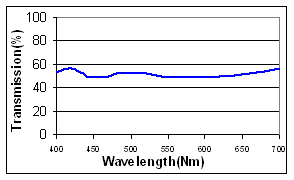
| These coatings are partially reflecting and may be used where a light beam needs to be split into two. Two types of Beamsplitter are available from Optiglass. | ||||||
| Polka-Dot Beamsplitters | Dielectric Beamsplitters | |||||
| 50/50 Beamsplitter for 45 deg | ||||||
|
|
 |
|||||
|
||||||
| MULTILAYER INTERFERENCE FILTERS | ||||||
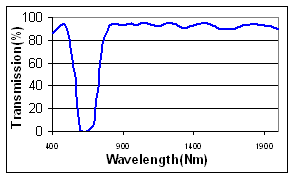
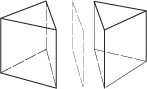
| Notch Filter for 633 Nm | Laser beam Splitter | |||||
 |
 |
|||||
| These can be used to pass
certain regions of the spectrum while rejecting others. The curve shown is for a Notch Filter designed for maximum reflectance at 633Nm and low reflectance in other spectral regions. |
||||||
HIGH REFLECTANCE METAL COATINGS. |
||||||
| Aluminium | ||||||
|
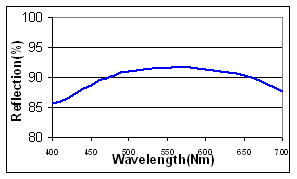
Unprotected aluminium provides good reflectance over most regions of the spectrum but cannot be easily cleaned. Aluminium can be protected with an overcoating of silicon dioxide which enables careful cleaning to take place. |
||||||
| Protected Aluminium | ||||||
| Two versions of Protected Aluminium are available: | ||||||
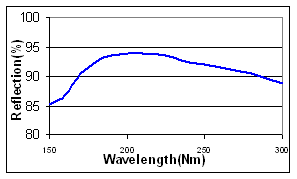
| UV Optimised | Visible Optimised | |||||
| UV Aluminium Mirror | Visible Aluminium Mirror | |||||
 |
 |
|||||
|
||||||
| Enhanced Aluminium | Mirror Coatings | |||||
 |
 |
 |
||||
|
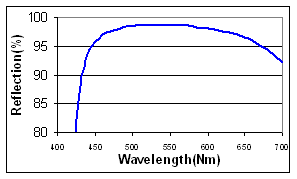
Aluminium can be overcoated with dielectric layers which increase its reflection in certain regions of the spectrum.Typical reflection is 95% average over the wavelength region 450-650 Nm. |
Mirrors
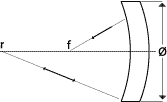
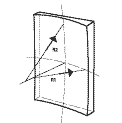
available in all Glass types & Fused Silica with a variety of optical coatings. |
|||||

 Cells
Reference
materials Mirrors Prisms
lenses coatings
Cells
Reference
materials Mirrors Prisms
lenses coatings