
 |
|||
|
Material Safety Data Sheet | |
|
| Section 1: Chemical Product and Company Information | |||
| Identity: RM-DG, UR-DG, Didymium glass filter. | |||
| Filter Identity: 'DG'. | 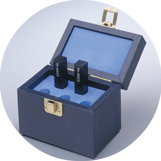 |
||
| Manufactured
by: Starna Scientific Ltd 52/54 Fowler Road, Hainault, Essex, England. Phone: +44 (0)20 8501 5550. Date of preparation:28 July 2008. Prepared by: John P. Hammond CSci CChem FRSC |
|||
| Section 2: Composition | |||
| Glass filter contains: Neodymium and Praesodymium oxides dispersed in a glass matrix | |||
| CAS No: 7631-86-9 (Glass) | |||
| Section 3: Hazards Identification | |||
| Under USA regulations, MSDSs are not required for these materials, and the information provided below is additional safety data as a service to our customers. Our reference filters are a fully-enclosed, manufactured item intended as an end-use product for customers. Therefore, our filter references are not classified as a "hazardous chemical" and are not treated as such under the U.S. OSHA Hazardous Communications Rule. Filter references are considered "articles" within the meaning of 29 CFR Section 1910.1200(c), since they are formed to a specific shape or design during manufacture, have an end-use dependent upon their shape or design, and do not release or otherwise result in exposure to hazardous chemicals under normal conditions of use. | |||
| Route of Entry - Inhalation: no (inert glass matrix). | |||
| Route of Entry - Skin: no (inert glass matrix). | |||
| Route of Entry - Ingestion:no (inert glass matrix). | |||
| Health Hazard acute and chronic: Due to the complete immobilisation of the neodymium and praesodymium oxides in the glass matrix, the only health hazard would be from a cut from the sharp edge produced if the filter is broken. | |||
| Signs and symptoms of exposure: none. | |||
| Medical Conditions aggravated by exposure: none. | |||
| Section 4: First Aid Measures | |||
| Under normal circumstances no measures are required for contact with the filter glass. In the event of breakage of the filter, safely dispose of the glass pieces, and treat as below. |
|||
| Inhalation: Remove to fresh air. If not breathing, give artificial respiration. If breathing is difficult, give oxygen. Get medical attention immediately. | |||
| Ingestion: If swallowed, DO NOT INDUCE VOMITING. Give large quantities of water. Never give anything by mouth to an unconscious person. Get medical attention immediately. | |||
| Skin Contact: Wash contacted area with plenty of water. If irritation occurs, seek medical attention. | |||
| Eye contact : Immediately flush eyes with plenty of water for at least 15 minutes, lifting lower and upper eyelids occasionally. Get medical attention immediately. | |||
| Section 5: Fire Fighting Measures | |||
| IIn the event of the heat from a fire causing fracture or melting of the glass, the small amount of the glass involved would not contribute to the incident or add any significant risk, and the measures shown below are for reference if the material is involved in a larger conflagration. | |||
| Suitable extinguishing agents: Carbon Dioxide, extinguishing powder, or water jet. | |||
| Protective equipment: Wear full protective clothing, and a self-contained breathing apparatus | |||
| Section 6: Accidental Release Measures | |||
| Spill: Dispose of contaminated product by usual local procedure for handling glass. | |||
| Section 7: Handling and Storage | |||
| When not being used for measurement, store closed in provided foam filled wooden box. | |||
| Protect from freezing. | |||
| Section 8: Exposure Controls, Personal Protection | |||
| Under normal use, no protective measures are required. In the event of a breakage, the following will apply to any glass fragments |
|||
| Respiratory Protection: none required. | |||
| Ventilation: none required. | |||
| Protective Gloves: Puncture resistant gloves. | |||
| Eye Protection: Impact prevention goggles. | |||
| Other protective equipment: Have immediate availability of eyewash. | |||
| Section 9: Physical and Chemical Properties | |||
| Appearance: Blue transparent glass. | |||
| Boiling Point: n/a. | |||
| Specific Gravity: n/a. | |||
| Vapour Pressure (mm Hg): n/a. | |||
| Melting Point: 545 °C. | |||
| Vapour Density: n/a. | |||
| Evaporation Rate: n/a. | |||
| Solubility in Water: insoluble. | |||
| Fire and Explosion Hazard: | |||
| Flash point: n/a. | |||
| Flammable limits: non-flammable. | |||
| Section 10: Stability and Reactivity | |||
| Stability: stable under normal operating conditions. | |||
| Conditions to avoid: Avoid contact with sharp edges if broken. | |||
| Incompatible Materials: none | |||
| Hazardous Decomposition Products: n/a | |||
| Hazardous Polymerization: n/a | |||
| Section 11: Toxicology Information | |||
| Routes of Entry: Inhalation, Ingestion Hazardous in case of ingestion. |
|||
| Carcinogenicity: none known . | |||
| Section 12: Ecological Information | |||
| Under normal conditions of use, these filter references do not constitute any risk or hazard to the environment. | |||
| Section 13: Disposal Considerations | |||
| Incineration: Never incinerate filter references. | |||
| Landfill: Never dispose of filter references as landfill. | |||
| Recycling: ‘Filter references must be recycled. Contact local Starna dealer for information. Starna Scientific has a recycling protocol for all types of returned filter references. | |||
| Section 14: Transport Information | |||
| Land transport ARD/RID and GGVS/GGVE (cross-border/domestic) ADR/RID-GGVS/E Class: None |
|||
| Maritime transport IMDG/GGVSea IMDG/GGVSea Class: None |
|||
| Air transport ICAO-TI and IATA-DGR ICAO/IATA Class: None |
|||
| Section 15: Regulatory information | |||
| Designed according to EC guidelines: Observe the normal safety regulations when handling chemicals. This ‘sealed-cell’ reference is not subject to classification according to EC lists and other sources of literature known to us. The product is not subject to identification regulations under EC Directives and the Ordinance on Hazardous Materials (German GefStoffV). | |||
| Section 16: Other information | |||
| Other: none. | |||
| Disclaimer: This information has been compiled from sources considered to be dependable and is, to the best of our knowledge and belief, accurate and reliable as of the date compiled. However, no representation, warranty (either expressed or implied) or guarantee is made to the accuracy, reliability or completeness of the information contained herein. This information relates to the specific material designated and may not be valid for such material used in combination with any other materials or in any process. It is the user’s responsibility to satisfy themselves as to the suitability and completeness of this information for their own particular use. We do not accept liability for any loss or damage that may occur, whether direct, indirect, indirect, incidental or consequential, from the use of this information nor do we offer warranty against patent infringement. Additional information is available by calling the telephone number above designated for this purpose | |||
