
Stray light

For the measurement of this fundamental parameter, Starna® offers you the choice of a range of materials in sealed cells.
Product Description:
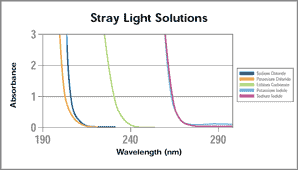
Starna® stray light Certified Reference Materials have very sharp transitional (cut-off) spectra, giving excellent filtering characteristics. Hence, below the specified cut-off wavelength, any indication of light transmission must be stray light.
The test for stray light is important even if the spectrophotometer is not used below 260 nm, because it is an excellent indication of the overall performance of the instrument optics, grating, and deuterium lamp.
Description: Materials with sharp cut-offs in transmission at specified wavelengths.
Primary Usage: Detection of stray light in the UV region.
Useable range: 200 nm to 390 nm, depending on the material.
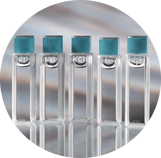
Physical Configuration: Far UV quartz cells that have been permanently heat sealed.
| Material | Cat.No | Cut-off | Concentration |
| Sodium Nitrite | RM-SN | 390nm | 5% aqueous |
| Potassium Iodide | RM-KI | 260 nm | 1% aqueous |
| Sodium Iodide | RM-SI | 260 nm | 1% aqueous |
| Lithium Carbonate | RM-LC | 227 nm | Saturated aqueous |
| Sodium Chloride | RM-SC | 205 nm | 1% aqueous |
| Potassium Chloride | RM-KC | 200 nm | 1.2% aqueous |
| Suggestions
for Use: Stray
light determinations are run against a water blank supplied with each
Certified Reference Material, and the procedure is similar for all
materials. Set the spectrophotometer wavelength 20 nm above the cut-off wavelength for example when using potassium iodide set the start wavelength to 280 nm. Scan down into the UV region, and record the peak absorbance observed below the cut-off wavelength. This is the Instrument Stray Light (ISL) reading for the instrument. |
 |
| Calibration
procedure: Traceability: Primary instrumental linearity is established using the Double Aperture method. Primary instrumental wavelength calibration is established using the emission lines from mercury and deuterium sources .Additional traceability links to NIST primary materials are established using SRM 2034 holmium oxide (4% m/v) in perchloric acid (10% v/v), SRM 930e and SRM 1930 neutral density glass filters. |
 |
 |
All appropriate fundamental parameters and procedures relating to measurement, handling and storage are fully documented on the certificate supplied with each Certified Reference Material. (see MSDS)
