

The smaller the slit and associated spectral bandwidth, the greater the resolution, but the corresponding reduction in energy means the signal-to-noise ratio falls. When measuring an absorbance band in a high-resolution instrument, it is recommended that the spectral bandwidth (SBW) should not exceed 10% of the natural bandwidth (NBW) of the band.
Therefore, simple checks on the resolution power of a spectrophotometer will ensure, for example that adjacent peaks will be fully resolved and not be blended into a combination peak with the associated wavelength, and absorbance errors.
For the measurement and checking of this fundamental parameter, Starna® offers you the choice of either a sealed liquid cell (0.02% v/v solution of toluene in hexane), or a sealed benzene vapour cell.
Description: 0.020% v/v solution of toluene in hexane.
Primary Usage: Determination of spectral bandwidth (SBW) in the UV region
Useable range: 265 nm to 270nm, instruments with a SBW of less than 3 nm.
Physical Configuration: Far UV quartz cells that have been permanently sealed.
Product Description:
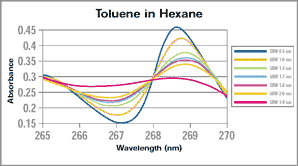
This formulation is described and used in the European Pharmacopoeia where the ratio of the peak maximum at 269 nm to the minimum at 266 nm gives a measure of the resolution of the instrument.
Ratio table:
SBW (nm): 0.5 1.0 1.5 2.0 3.0
Ratio:.......... 2.5 2.1 1.6 1.4 1.0
Suggestions for Use:
Resolution determinations are run against the hexane blank supplied with each
 |
 |
Certified
Reference Material, and the procedure is similar for all spectral
bandwidths. Scan the 265-270 nm region, and calculate the peak maxima and minima. Calculate the peak/trough ratio and compare to the reference values Calibration procedure: Traceability: Primary instrumental linearity is established using the Double Aperture method. Primary instrumental wavelength calibration is established using the emission lines from mercury and deuterium sources. |
 |
|
Additional
traceability links to NIST primary materials are established using
SRM 2034 holmium oxide (4% m/v) in perchloric acid (10% v/v), SRM
930e and SRM 1930 neutral density glass filters.
(see MSDS) Use: All appropriate fundamental parameters and procedures relating to measurement, handling and storage are fully documented on the certificate supplied with each Certified Reference Material. |
 Cells
Reference
materials other products
Mirrors Prisms lenses
coatings
Cells
Reference
materials other products
Mirrors Prisms lenses
coatings