
Far UV Wavelength reference materials

For the measurement of this fundamental parameter, Starna® offers you sealed cell materials. Please note that your selection process should not only include the wavelength(s) required, but also the spectral bandwidth (SBW) of your spectrophotometer. Use of the reference materials outside the SBW range detailed is not excluded, but at higher spectral bandwidths some of the certified peaks may not be resolved from the overall
background spectrum.
Description: Rare earth oxide in dilute sulphuric acid.
Primary Usage: Assessment of wavelength scale accuracy in the UV region.
Useable range: 200nm to 300nm, instruments with spectral bandwidth of less than 5nm.
Physical Configuration: Far UV quartz cells that have been
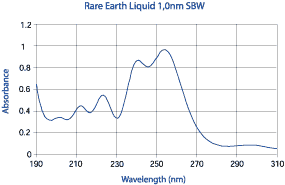
The use of rare earth oxides solvated in acid is an established and well recognised method for the validation of the wavelength scale of a spectrophotometer in the UV and visible regions. When prepared in sulphuric acid, this rare earth gives a spectral scan containing a series of characteristic peaks that extend into the Far UV region. (see MSDS)
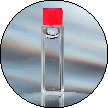
| RM-RE: Consists of one sealed cell, with certified peak at spectral bandpass values of 0.1nm, 0.2nm, 0.5nm, 1.0nm, 1.5nm, 2.0nm and 3.0nm. Typical values obtained: |
|
| SBW | nm | nm | nm | nm | nm |
| 0.10 | 201.14 | 211.14 | 222.92 | 240.00 | 253.56 |
| 0.25 | 201.16 | 211.96 | 222.82 | 240.44 | 253.80 |
| 0.50 | 200.98 | 212.00 | 222.86 | 240.26 | 253.58 |
| 1.00 | 201.44 | 211.72 | 223.02 | 240.48 | 253.74 |
| 1.50 | 201.34 | 211.96 | 222.86 | 240.38 | 253.58 |
| 2.00 | 201.34 | 212.00 | 223.02 | 240.72 | 253.52 |
| 3.00 | 201.34 | 211.96 | 222.86 | 240.72 | 253.64 |
 |
Calibration
procedure: Traceability: • Primary instrumental wavelength calibration is established using the emission lines from mercury and deuterium sources. • Additional traceability links to NIST primary materials are established using SRM 2034 holmium oxide (4% m/v) in perchloric acid (10% v/v). Use: • All appropriate fundamental parameters and procedures relating to measurement, handling and storage are fully documented on the certificate supplied with each Certified Reference Material. |

Cells Reference materials other products Mirrors Prisms lenses coatings