
Far UV Absorbance/Transmission reference material
Description: Nicotinic acid in 0.1M hydrochloric acid.
Primary Usage: Testing absorbance scale and linearity in the UV region.
Useable range: 210nm to 270nm, instruments with a SBW of 2 nm or less.
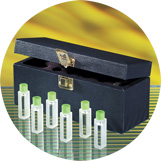
Physical Configuration: UV quartz cells that have been permanently heat sealed.
Product Description:
The use of nicotinic acid solvated in dilute hydrochloric acid is a well documented method for the validation of the absorbance scale and linearity of a spectrophotometer in the Far UV region.
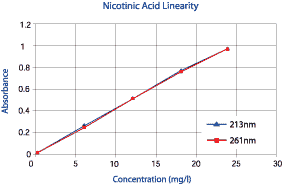
When prepared in 0.1M hydrochloric acid, nicotinic acid gives a spectral scan containing characteristic peaks at approx. 210nm and 260nm. Within the concentration range 5-25 mg/l, if the absorbance scale of a narrow SBW (Ž 2 nm) spectrophotometer is linear, the apparent absorbances of a series of concentrations will be a linear function of concentration, at a specified SBW.
Traceability:
• Primary instrumental linearity is established using the Double Aperture method.
• Additional traceability links to NIST primary materials are established using SRM 935a potassium dichromate, SRM 930e and SRM 1930 neutral density glass filters.
 |
 |
RM-UVA
(1A2A3A4A) set:
|
 |
•
Use: • All appropriate fundamental parameters and procedures relating to measurement, handling and storage are fully documented on the certificate supplied with each Certified Reference Material. (see MSDS)
|

 Cells
Reference
materials other products
Mirrors Prisms lenses
coatings
Cells
Reference
materials other products
Mirrors Prisms lenses
coatings