
Reference materials & Magnetic stirring |
||||||||
|
||||||||
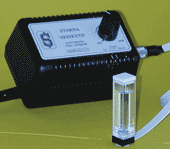
| ‘Spinette’ cell stirrer (see Magnetic stirring Cells) | ||||||||
| ‘Spinette’
cell stirrers offer the ability to simultaneously measure and stir
the contents of specially designed cells (MS), see page 27. Mixing
of solutions is with a tiny magnetic stir bar placed into
a purpose made well at the bottom of the cell. A small electronic
coil rotation assembly is placed under the cell in the sample compartment.
This raises the cell by 5mm which, without affecting instrument operation
may also reduce the required sample volume. The ‘Spinette’
will fit all standard spectrophotometers
cell holders. The speed of rotation can be adjusted with the controller which is connected to the electronic magnet by thin ribbon wire one metre in length. This will not interfere with insertion or removal of cells from the sample compartment and will also allow instrument covers to close normally. The Spinette cell stirrer is supplied complete with speed controller, electronic rotation platform, ribbon wire and one stir bar. There are two models available, one with input voltage of 110 VAC and the other 220/240 VAC, see below. |
 |
|||||||
| Type No. | Description | |||||||
| SCS1.22
SCS1.11 |
Spinette
cell stirrer 240 VAC Spinette cell stirrer 110 VAC |
|||||||
|
|
||||||||
| Magnetic stir bars (see Magnetic stirring Cells) | ||||||||
| Teflon
coates magnetic stir bars,are available in packs of 10 to fit the
MS range of cells (Magnetic
stirring Cells). Types 18/MS and 25/MS need the MSB/6x1.5 to allow the stirring bar to enter the narrow sample compartment. |
 |
|||||||
| Type No. | Dimensions | |||||||
| MSB/5 x 2/10 | 5mm long x 2mm diameter | |||||||
| MSB/6 x 1.5/10 | 6mm long x 1.5mm diameter | |||||||
| MSB/6 x 3/10 | 6mm long x 3mm diameter | |||||||
|
|
||||||||
| Fluorescent reference materials (see Starna reference materials) | ||||||||
| Molecular
fluorescence spectroscopy is a sensitive and often selective technique.
Unlike absorption spectrophotometry it is not an absolute technique:
instruments therefore require calibration before every series of measurements.
This may be achieved using a stable reference material, which should
absorb and emit at similar wavelengths to the samples of interest.
Use of the general purpose fluorescent reference material set type
6BF enables the day to day stability of instruments to be measured.
The 6BF reference materials are not standards with absolute values, but a set of six stable fluorescent materials in a polymethylmethacrylate matrix with which the stability and precision of the instrument can be monitored. Four blocks exhibit broad band spectra which cover the normally used UV and visible region of the spectrum, with considerable overlap. Two blocks contain materials suitable for illustrating the selectivity of the technique as well as checking instrument resolution and wavelength calibration. The materials have the following advantages: |
 |
|||||||
| Stability:
no degradation, no evaporation. Safety: no chemicals to mix. Robust: unbreakable, easy to store and use. |
||||||||
| Further information can be found in the Starna® booklet entitled: "Reference Materials for Molecular Fluorescence Spectrophotometry . pdf " | ||||||||


